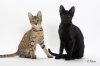
Black is an accepted color in Savannahs, you will often see them labeled as "melanistic" also. It's a black on black pattern so in sunlight you can often see the pattern and that is really cool too 
I find the larger ones are often more docile really...the crazy ones are the little girls. You usually do see a big size difference between girls and boys... for example the litter with Jobs, both boys are huge but their sister is a petite 8lbs to their 18lbs. Baz is close to 20lbs but his littermate sister Maddie is ~10lbs.
 That's a pic of Baz with his sister that might demonstrate the size difference in the same litter that is possible!
Theoretically, the Savannah breed should be healthy because so many outcrosses were used to make our foundation cats. But there are some catteries that practice inbreeding, it's accepted in many types of breeding to inbreed to "set traits" etc, I personally prefer to have genetic diversity and avoid inbreeding, but there are some lines in Savannahs that have a higher inbreeding coefficient.
I do think with the Savannah breed being developed in the internet age, we hear quicker about health issues to be aware of them, which I think allows earlier recognition of any issues. I personally screen all my breeding cats for heart defects/disease before using in a program, and have DNA tested for PK Deficiency as both of these are things that (1) we can test for and (2) are found in breeds used in development of our breed. I think in general, by buying a purpose-bred cat you should have the ability to find a healthier cat simply because the lineage is known. When you don't know the lineage you don't know how early the parents or grandparents died... HCM (the biggest cause of heart disease in cats) is found in the feral cat population as well as in breeds of cats for example. So by seeking out a reputable breeder you should have greater expectation of a healthier kitten.
I find the larger ones are often more docile really...the crazy ones are the little girls. You usually do see a big size difference between girls and boys... for example the litter with Jobs, both boys are huge but their sister is a petite 8lbs to their 18lbs. Baz is close to 20lbs but his littermate sister Maddie is ~10lbs.
That's a pic of Baz with his sister that might demonstrate the size difference in the same litter that is possible!Theoretically, the Savannah breed should be healthy because so many outcrosses were used to make our foundation cats. But there are some catteries that practice inbreeding, it's accepted in many types of breeding to inbreed to "set traits" etc, I personally prefer to have genetic diversity and avoid inbreeding, but there are some lines in Savannahs that have a higher inbreeding coefficient.
I do think with the Savannah breed being developed in the internet age, we hear quicker about health issues to be aware of them, which I think allows earlier recognition of any issues. I personally screen all my breeding cats for heart defects/disease before using in a program, and have DNA tested for PK Deficiency as both of these are things that (1) we can test for and (2) are found in breeds used in development of our breed. I think in general, by buying a purpose-bred cat you should have the ability to find a healthier cat simply because the lineage is known. When you don't know the lineage you don't know how early the parents or grandparents died... HCM (the biggest cause of heart disease in cats) is found in the feral cat population as well as in breeds of cats for example. So by seeking out a reputable breeder you should have greater expectation of a healthier kitten.